
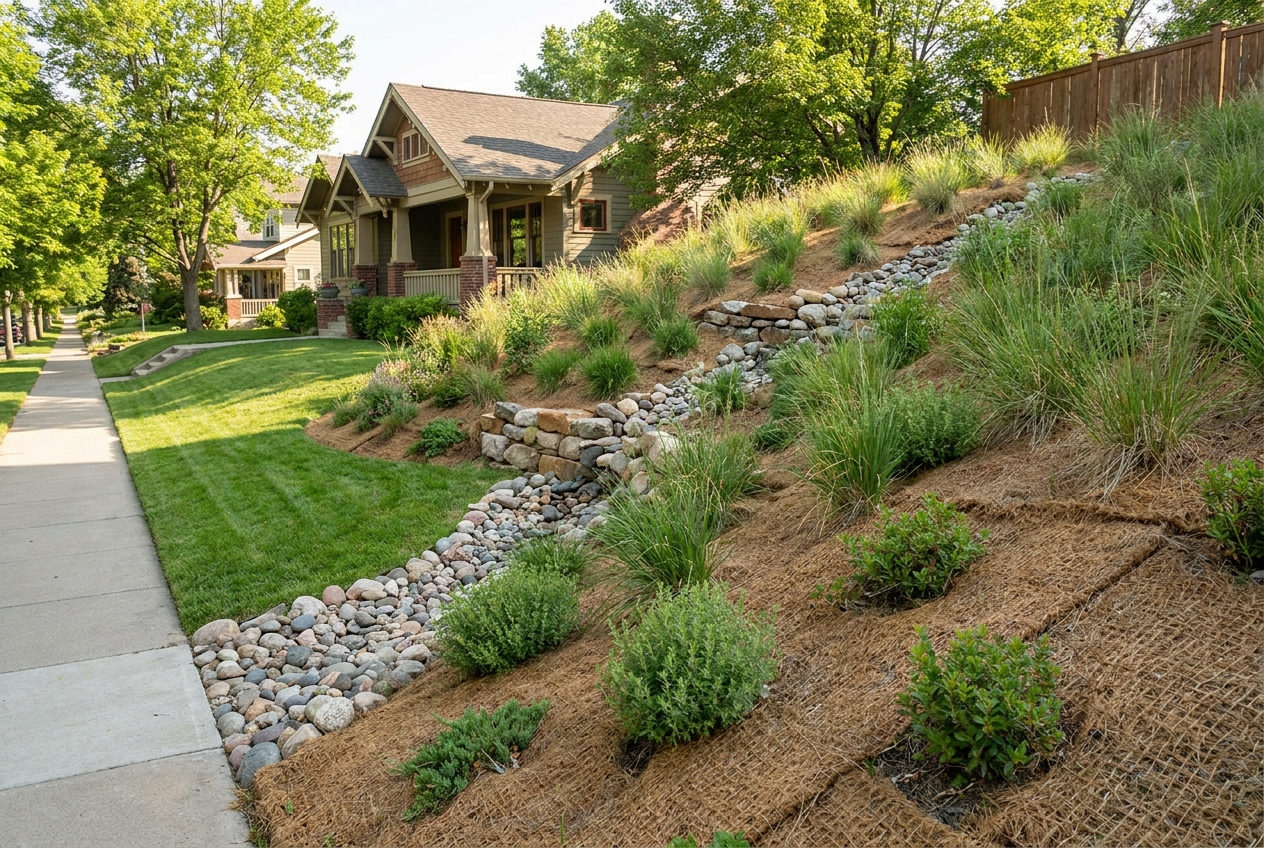


In 2026, erosion control cost typically falls between $946 and $3,274, with many projects landing near $1,828.
This guide walks through the biggest cost drivers, common material options, and smart hiring tips, based on established landscape construction practices[1].
Key takeaways
Low-end projects can begin at $946.
Many standard jobs center around $1,828.
Complex sites or premium solutions may reach $3,274.
Material choice, slope, and permits are major price drivers.
Experienced installation can reduce failures and repeat work.
Erosion Control Cost by Material
The erosion-control material you choose affects both upfront cost and how well the fix holds up over time. Some options are built for quick vegetation establishment, while others are designed to handle heavier water flow or ongoing washout.
Aim to match strength, visibility, and maintenance needs to your site. A mismatch often leads to repairs, failed seeding, and more disruption later. These choices can also align with resource-conserving landscaping practices, especially when they reduce runoff and repeated disturbance[2].
| Item | Cost | Description |
|---|---|---|
Coir Blanket | $582 - $1,712 | Biodegradable coconut-fiber matting used to protect seed and encourage vegetation on moderate slopes. Chosen for a natural look and gradual soil integration. |
Silt Fence | $438 - $1,364 | Temporary barrier fabric installed along contours to trap sediment on disturbed ground. Common for short-term control during active work. |
Erosion Control Mat | $724 - $2,146 | Heavy woven or stitched mats that stabilize soil on steeper slopes and channels. Typically longer-lasting and more reinforced than basic blankets. |
Straw Wattle | $392 - $1,188 | Rolled straw placed in contour trenches to slow runoff and capture sediment. Often used for small landscape areas and straightforward installs. |
Geotextile Fabric | $786 - $2,448 | Permeable synthetic fabric used for separation, filtration, and reinforcement under swales, drains, driveways, or riprap. Durable and helps reduce settling in many systems. |
Riprap Stone | $1,188 - $4,284 | Loose or sized rock placed in channels, banks, and outlets to resist scouring. A durable choice for higher-velocity flow areas. |
Wood Retaining Wall | $2,284 - $7,426 | Timber walls that hold back soil and create terraces. Can look finished, but needs proper drainage and periodic maintenance. |
Material pricing also reflects the site. Steeper slopes, tight access, and longer expected lifespan usually push costs up. Heavier options like riprap or structural walls often cost more because of excavation, hauling, and equipment needs.
Supply and prep can shift the total as well. Jobs that require imported soil or amendments can be influenced by topsoil delivery prices. Labor increases when crews must shape, anchor, or carry materials on steep or difficult terrain.
Types of Erosion Control
Erosion control can mean anything from short-term sediment barriers to long-term structural stabilization. Your price depends on scope, site conditions, material selection, and how quickly the work needs to happen.
| Type of Service | Cost | Features |
|---|---|---|
Install Erosion Control Barrier | $468 - $1,486 | Temporary or permanent barriers such as silt fences, wattles, or sandbags placed to limit sediment movement during grading or storms. |
Install Erosion Control Blanket | $612 - $1,784 | Blankets anchored to slopes to reduce rain impact, protect soil, and support seed germination. |
Repair Erosion Control Barrier | $226 - $724 | Patch, reset, or re-anchor damaged barriers after storms, animals, or construction activity. |
Replace Erosion Control Blanket | $642 - $1,968 | Remove worn or contaminated blankets and install new material to restore slope protection. |
Inspect Erosion Control Structure | $188 - $548 | Professional assessment of fences, terraces, blankets, and drainage to identify failures and potential compliance issues. |
Apply Hydroseeding | $686 - $1,916 | A slurry of seed, mulch, and fertilizer applied over bare soil to establish ground cover and reduce runoff. |
Build Retaining Wall | $3,186 - $10,874 | Timber, block, stone, or concrete walls built to hold back soil on steep grades and reduce slope movement. |
Apply Hydroseeding Costs
Hydroseeding is often used to establish grass or ground cover on bare soil and newly graded slopes. Typical pricing runs $686 - $1,916, with an average near $1,184. Final cost depends on area size, seed mix, mulch type, slope steepness, and access.
Regional pricing patterns and seed choices also influence published hydroseeding costs. Establishment improves when species and site conditions are matched appropriately[3]. On steeper slopes or in higher-flow areas, hydroseeding is often paired with blankets, tackifiers, or other measures so seed is less likely to wash out before roots take hold.
Build Retaining Wall Costs
Retaining walls are used when grade changes or steep slopes threaten landscaping, hardscapes, or nearby structures. Costs typically range from $3,186 - $10,874, with an average around $6,128.
The largest cost drivers are wall height, material selection, drainage and footings, excavation, permits, and whether engineering or heavy equipment is needed. Taller walls or walls supporting loads may require permits, engineered plans, and inspections.
Install Erosion Control Blanket Costs
Erosion control blankets help protect slopes right away and support seed germination. Expect costs in the range of $612 - $1,784, with an average near $1,088. Pricing depends on blanket type (coir, straw, synthetic), slope angle, anchoring method, and total square footage.
Costs for Emergency Erosion Control
After a washout or a heavy storm, emergency erosion control focuses on stopping active damage, especially when runoff threatens a foundation or undermines a slope. Emergency work often costs more because crews mobilize quickly, may work outside normal hours, and may need temporary materials and equipment.

Emergency installs typically run $1,186 to $4,028, with same-day barrier repairs, after-hours blanket replacement, and temporary barrier work in similar emergency-rate territory.
Emergency measures usually focus on quick stabilization to protect foundations and grading, which is consistent with rehabilitation guidance that emphasizes controlling moisture and limiting ongoing damage[4]. These temporary fixes help limit soil movement while a permanent plan is developed.
If erosion is actively moving, undermining foundations, or exposing utilities, skip DIY. Contact qualified professionals and, when appropriate, local authorities or an engineer.
When you request quotes, ask for a scope that clearly separates:
- temporary stabilization, and
- permanent repair or replacement.
Also confirm timelines, materials, and any same-day or after-hours fees so you can compare bids without surprise charges.
6 Factors That Affect Erosion Control Cost
Erosion control pricing comes down to site conditions, the level of protection needed, and how much prep or repair is required. These are the most common cost factors.
- Slope Steepness: Steeper slopes often need stronger materials, more anchoring, added safety steps, and sometimes specialized equipment.
- Soil Type and Stability: Loose or highly erodible soils may require heavier reinforcement or more maintenance. Soil testing or geotechnical evaluation can add to the upfront cost.
- Drainage and Water Flow: Concentrated runoff and poor drainage can require diversion channels, underdrains, or larger structures, which increases complexity and labor.
- Vegetation and Root Structure: Existing plant cover can reduce material needs. Tree roots and major pruning decisions can affect the approach, and municipal tree maintenance standards can shape how crews handle pruning and root impacts during work[5].
- Project Size and Accessibility: Bigger areas need more material and labor. Tight access, steep banks, or limited staging space typically increase crew time and equipment costs.
- Permits, Regulations, and Additional Services: Permits, mitigation requirements, retaining walls, riprap, or hydroseeding can add fees and specialized trades. For related estimates and categories, visit home services pricing. Work near wetlands, streams, shorelines, stormwater controls, or HOA-regulated areas may need approvals, and skipping them can lead to fines or removal orders.
Erosion Control Cost By Size
Size and layout have a direct impact on total cost. Larger areas require more material and labor, and oddly shaped or scattered work increases setup time. Erosion work is often planned alongside broader landscaping budget, especially on properties with grading, planting, or drainage already underway.
Plantings and ground cover are often part of long-term stabilization plans, and homeowner preferences and maintenance habits can influence how vegetation is used in a project[6].
Small Perimeter Around a Foundation
A small perimeter around a home foundation is usually a narrow strip focused on preventing washout near footings and walkways. Work often includes light grading, fabric or matting, and mulch or gravel, commonly covering one or two sides of the home.
- Cost Range: $728 - $2,246
- Average Cost: $1,334
Costs increase when crews need precise grading near structures or must work in tight access areas. Material selection also matters, and grading should preserve proper drainage away from the house and maintain clearances at siding and weep holes. Poor grading can worsen moisture problems.
Sloped-Bank Stabilization
Sloped-bank stabilization addresses an eroding hillside or berm. Projects typically include contouring, blankets or wattles, and planting ground cover to reduce surface runoff.
- Cost Range: $1,088 - $3,724
- Average Cost: $2,086
Steeper slopes require more labor, added safety steps, and sometimes specialty anchoring. Longer slopes may need terracing, added fabric coverage, or irrigation for new plantings.
Linear Runs Along a Property Line
Linear runs along a property line are common when water tracks along a fence or when neighboring drainage issues overlap. Solutions might include swales, sediment barriers, and continuous matting.
- Cost Range: $864 - $2,748
- Average Cost: $1,586
Length is the main driver. Costs increase when access is narrow, materials must be overlapped and joined continuously, or fill and rock must be moved long distances.
Runoff Zone Protection
Runoff zones such as downspout outlets, driveway drains, or low spots often need heavier protection. Typical work includes rock aprons, engineered swales, or reinforced mats to reduce scour.
- Cost Range: $986 - $3,564
- Average Cost: $1,918
Flow volume and velocity usually determine pricing. Heavier rock, concrete elements, or engineered channels cost more than basic vegetative solutions. Fixing the source, such as poor drainage, can add labor and materials.
Scattered or Multiple-Area Treatments
Scattered or multiple-area treatments address several smaller problems across a property. These projects often combine small swales, check dams, and localized regrading.
- Cost Range: $1,164 - $3,876
- Average Cost: $2,178
Moving between areas increases setup time and may require multiple material types. Contractors may price by location, and combined planting, grading, and hardscaping can raise the total.
Erosion Control Blanket Cost Per Square Foot
Many contractors quote erosion control by the square foot because both material coverage and install time scale with area. Per-square-foot pricing often includes the product, standard labor, anchoring, and basic prep, which can make bid comparisons easier.
Unit pricing is most useful when bids include the same scope. Ask what is included and what is separate, such as seeding, heavy grading, or debris removal.
| Service Type | Cost | Details |
|---|---|---|
Install Erosion Control Blanket | $1 - $4 | Varies by blanket type, anchoring method, and slope. Labor is a major driver. |
Install Erosion Control Barrier | $1 - $3 | Includes silt fence or wattles. Access, stake spacing, and soil conditions influence cost. |
Apply Hydroseeding | $0.42 - $1 | Depends on seed mix, mulch or tackifier, and equipment setup time. |
Build Retaining Wall | $28 - $79 | Often quoted by square face foot or linear foot. Confirm the unit used; reinforcement, drainage, and footings raise costs. |
Remove Failed Erosion Control Material | $0.68 - $2 | Driven by material type, contamination, and hauling or disposal needs. |
Maintain Erosion Control System | $0.34 - $1 | Routine inspections, repairs, and reseeding. Labor depends on access and site complexity. |
Per-square-foot rates still change with slope, access, soil, and vegetation. More difficult terrain usually means more time, safety measures, and anchoring, which raises the unit cost.
Contractors often rely on unit pricing methods to estimate labor and adjust for job complexity[7]. Ask for itemized bids so you can confirm you are comparing the same materials and tasks across quotes.
Erosion Control Repair vs. Replacement Costs
Repair and replacement can look similar on a proposal, but the scope is different. Repair focuses on specific failures, while replacement removes the existing system and installs a new one. The table below compares typical pricing ranges and the situations each option fits best.
| Option | Cost | Considerations |
|---|---|---|
Replace | $768 - $2,648 | Higher upfront cost, typically longer service life. Often the better fit when failures are widespread or materials are at end of life. |
Repair | $412 - $1,468 | Lower immediate cost and faster turnaround. Best for localized damage, but may need repeat work if underlying issues remain. |
When to Choose Replacement
Replacement is usually the better fit when the system is old, extensively damaged, or repeatedly failing. It is also worth considering when drainage patterns have changed, or when repair costs are stacking up. If the underlying problem is design or drainage related, a redesigned system may be needed regardless of how many repairs have been attempted. Longer-lasting solutions often align with durability-focused building guidance and can reduce repeat maintenance cycles[8].
When to Choose Repair
Repair is a practical choice when damage is limited, the system is relatively new, or you need a short-term fix while planning a larger project. A targeted repair can extend service life, especially when the original installation is otherwise performing well.
ROI of Erosion Control
Erosion control is often about preventing expensive problems, but it can also support resale appeal by stabilizing outdoor areas and protecting landscape investments. ROI depends on how visible the issue is, how well the solution performs, and how much ongoing maintenance it needs.
Key ROI Drivers
- Material Quality and Durability: Longer-lasting materials can reduce rework and replacement.
- Professional Installation: Correct grading, drainage, and anchoring reduce failure risk.
- Market Demand: In runoff-prone areas, buyers may value reliable stabilization.
- Maintenance Requirements: Lower-maintenance systems tend to hold value better over time.
- Curb Appeal and Aesthetics: Vegetation and trees used for erosion control can contribute to perceived property value[9].
- Incentives and Regulations: Local rebates and conservation programs may improve net cost, where available.
Below are common project types and typical ROI ranges. Use these as planning benchmarks, not guarantees.
| Service | Estimated ROI | Details |
|---|---|---|
Vegetative Stabilization (plantings, live stakes) | around 60-80% | Lower-cost approach that stabilizes soil and improves appearance. Maintenance affects longevity. |
Basic Repair (small grading, erosion matting) | around 50-65% | Addresses localized problems and helps prevent spread. Moderate resale impact. |
Structural Solutions (retaining walls, riprap) | approximately 55-70% | Durable for steep slopes, higher upfront cost, often valued for protection and buyer confidence. |
Integrated Landscape Erosion Control (grading, planting, drainage) | around 70-85% | Broader approach that supports long-term performance and curb appeal. |
ROI depends on local market conditions, property layout, and workmanship quality. Many homeowners also value the non-financial benefits, like improved safety and fewer storm-related surprises.
Erosion Control Cost Per Hour
Hourly pricing typically covers labor and basic equipment time. You will see hourly billing most often for inspections, troubleshooting, or smaller repairs where the scope can change once work begins. Larger installations are more commonly priced as a flat bid.

General installation typically bills at $78 to $158 per hour, with barrier repair, blanket replacement, inspections, and failed-material removal in similar hourly ranges depending on the task. Local wages for landscaping and groundskeeping work can influence the labor portion of erosion control pricing[10]. Before you approve hourly work, ask whether the invoice includes travel time, equipment fees, and material markup. For a straightforward small job, compare an hourly estimate to a flat project price to see which offers clearer value in 2026.
Add-Ons for Erosion Control
Add-ons are upgrades you can include to improve performance, appearance, or long-term stability. They increase the project total, but they can reduce maintenance and improve how well vegetation establishes. Planning and layout tools can also help homeowners and contractors visualize placements and avoid conflicts[11].
| Add-On | Cost | Details |
|---|---|---|
Soil Testing | $124 - $386 | Lab analysis of pH, texture, and nutrients to guide seed selection and amendments. Useful for new installs or problem soils. |
Drainage Installation | $882 - $3,662 | Trenching, pipes, and outlet connections to move water away from vulnerable areas and reduce undermining. |
Mulch Application | $186 - $724 | Install and anchor straw, wood fiber, or wood chips to protect seed and reduce runoff. Some projects upgrade to blankets separately. |
Native Planting | $426 - $1,584 | Deep-rooted local grasses and shrubs for long-term stabilization. May reduce long-term maintenance. |
Slope Grading | $612 - $2,482 | Reshaping to reduce steepness or add terraces. Improves runoff control but increases equipment time and labor. |
Watering System | $518 - $2,146 | Temporary or permanent irrigation for establishing vegetation, such as drip lines, sprinklers, and timers. |
Erosion Monitoring | $164 - $586 | Periodic inspections and reporting to verify performance and spot failures early, often as part of a maintenance plan. |
Add-on pricing depends on site complexity, equipment needs, and the materials selected. Steeper yards and limited access raise labor and machine time, while premium fabrics, plants, and automated watering increase material costs.
Some add-ons require permits or specialty subcontractors, which can affect availability and scheduling. Drainage upgrades can change the scope significantly. For example, the cost of french drains shows how adding drainage elements can shift the overall project budget.
DIY vs. Professional Erosion Control Costs
DIY erosion control can work for small, low-risk areas, but cost is not just about materials. Time, safety, and performance matter, especially when runoff is concentrated or a slope is actively eroding.

Common DIY Risks and Practical Challenges
DIY installs fail most often because of incomplete coverage, weak anchoring, or incorrect placement for water flow. Storms can exploit small gaps fast, especially on steep slopes or where runoff concentrates. Grade changes and drainage alterations can also create problems for neighboring properties, or conflict with local rules and HOA requirements, so confirm requirements before making major changes.
Installing a barrier yourself typically runs $138 to $416, against $486 to $1,528 for a pro, with similar gaps on blankets, repairs, and hydroseeding.
How to Decide Between DIY and Pro Work
A qualified contractor can evaluate drainage patterns, select appropriate materials, and install anchoring and grading correctly. Professionals also have access to equipment that is difficult for homeowners to rent and operate safely on steep or unstable ground. For projects involving trees, drainage changes, or steep slopes, consider contractors who coordinate with credentialed arborists and related specialists[12].
DIY can be a fit for small areas with gentle slopes and predictable drainage, especially if you can monitor the site after rain. Professional help is the safer choice for larger areas, active washouts, critical drainage paths, or projects involving permits or engineered solutions.
If budget is tight, a hybrid approach can help. Hire a pro for design and critical installations, then handle routine monitoring and minor maintenance yourself. Before digging or grading, call 811 or your local utility locator, and identify septic and drainage lines.
How Season Affects Erosion Control Costs
Season affects both pricing and scheduling in 2026. Spring and early summer are often busy as homeowners prepare for wet weather, while winter conditions can limit what contractors can install. Local climate, contractor backlog, and planting windows for vegetation-based work all play a role.
| Season | Cost | Description |
|---|---|---|
Spring / Early Summer | $986 - $3,382 | High demand can increase lead times and sometimes pricing, especially for quick scheduling. |
Summer | $958 - $3,296 | Dry conditions may improve access and speed, but high workload can keep pricing elevated. |
Autumn | $972 - $3,338 | Stabilization before winter can drive demand. Work windows can be shorter due to weather. |
Winter | $1,036 - $3,584 | Frozen ground can limit options and require extra prep, which may increase cost or delay schedules. |
Seasonal pricing is often driven by three realities:
- Peak Demand: Busy schedules can lead to longer waits and higher labor premiums.
- Weather Limitations: Rain, frozen ground, or extreme heat can affect site prep and material choices. Guidance on managing runoff and chemical movement in wet conditions highlights why heavy rain can change erosion-control strategy and performance[13].
- Planting Windows: Seeding and planting are more likely to succeed during recommended local windows. Off-season installs may require added irrigation or rework.
Erosion Control Cost by Region
Regional pricing differences come from climate, soils, labor rates, access to materials, and permitting requirements. Even within the same region, prices can shift based on local suppliers and contractor availability.
| Region | Cost | Description |
|---|---|---|
Northeast | $1,028 - $3,448 | Cold winters and rocky soils may require heavier stabilization and added labor. |
Midwest | $888 - $3,042 | Freeze-thaw cycles and variable soils can require more durable solutions and careful scheduling. |
South | $842 - $2,924 | Higher rainfall intensity and fast vegetation growth can drive more frequent stabilization and maintenance. |
West | $1,084 - $3,688 | Steep terrain, arid soils, and stricter runoff rules in some areas can increase engineering and material needs. |
Some sites require extra attention to local soil and groundwater conditions, which can increase complexity and cost[14]. Areas with wildfire burn scars, coastal storm exposure, or landslide-prone hillsides may also face stricter standards and more permitting.
To compare bids more easily, ask for line items that separate labor, materials, equipment, and permits.
How to Save on Erosion Control
You can often reduce erosion control costs by cutting wasted labor time and avoiding rework, without lowering the quality of the solution.
- Plan Work in Phases: Address the highest-risk areas first, then schedule less urgent sections later.
- Prepare the Site Yourself: Clear debris, flag plants to protect, and mark access points so crews spend less time on basic prep.
- Consolidate Deliveries and Staging: Coordinate drop-offs, parking, and material staging to reduce equipment moves.
- Choose Lower-Maintenance Options: Native plants and durable fabrics can reduce ongoing touch-ups and disturbance.
- Check Government Assistance: Some homeowners may qualify for grants or low-cost loan programs for repairs, depending on location and eligibility[15].
For a clear scope and pricing you can compare, reach out to local landscaping contractors through homeyou to review options and plan a durable fix for your property.
Frequently Asked Questions About Erosion Control
References
[1] Sorvig, Kim, and J. William Thompson, "Sustainable Landscape Construction", https://doi.org/10.5822/978-1-61091-811-4.
[2] United States Environmental Protection Agency, "Resource Conserving Landscaping", https://archive.epa.gov/.
[3] Brancalion, Pedro H. S. and Karen D. Holl, "Guidance for Successful Tree Planting Initiatives", Journal of Applied Ecology, https://doi.org/10.1111/1365-2664.13725.
[4] U.S. Department of Housing and Urban Development, "The Rehab Guide Foundations", https://huduser.gov/publications/pdf/foundations.pdf.
[5] O'Brien, Patrick, et al, "Performance Standards for Municipal Tree Maintenance", Arboriculture & Urban Forestry, https://doi.org/10.48044/jauf.1992.059.
[6] Summit, Joshua and E. Gregory McPherson, "Residential Tree Planting and Care A Study of Attitudes and Behavior in Sacramento, California", Arboriculture & Urban Forestry, https://doi.org/10.48044/jauf.1998.012.
[7] Abbott, Richard, and Kenneth Miller, "Estimating and Pricing Tree Care Jobs", Arboriculture & Urban Forestry, https://doi.org/10.48044/jauf.1987.025.
[8] U.S. Department of Housing and Urban Development, "Durability by Design A Guide for Residential Builders and Designers", https://huduser.gov/portal/sites/default/files/pdf/Guide-Durability-by-Design.pdf.
[9] Anderson, L. M. and H. K. Cordell, "Residential Property Values Improved by Landscaping With Trees", Southern Journal of Applied Forestry, https://doi.org/10.1093/sjaf/9.3.162.
[10] Bureau of Labor Statistics, "Landscaping and Groundskeeping Workers", https://bls.gov/oes/2022/may/oes373011.htm.
[11] Hansen, Gail, et al, "Landscape Design Software: Evaluation and Recommendations for Homeowners", EDIS, https://doi.org/10.32473/edis-ep526-2015.
[12] International Society of Arboriculture, "ISA Certified Arborist", https://isa-arbor.com/credentials/types-of-credentials/isa-certified-arborist.
[13] "Research Report Impact of Ant Control Technologies on Insecticide Runoff and Efficacy", NPMA PestWorld, https://npmapestworld.org/content-pages/technical-resources/pmf-research-reports/research-report-impact-of-ant-control-technologies-on-insecticide-runoff-and-efficacy.
[14] A. Eastwood, David, "RECOMMENDED GUIDELINES FOR DESIGN AND CONSTRUCTION OF INGROUND SWIMMING POOLS IN HOUSTON, TEXAS", GEOTECH ENGINEERING and TESTING, https://foundationperformance.org/pastpresentations/EastwoodPresPaper-12Sep07.pdf.
[15] "Government Home Repair Assistance Programs", USAGov, https://usa.gov/home-repair-programs.


