
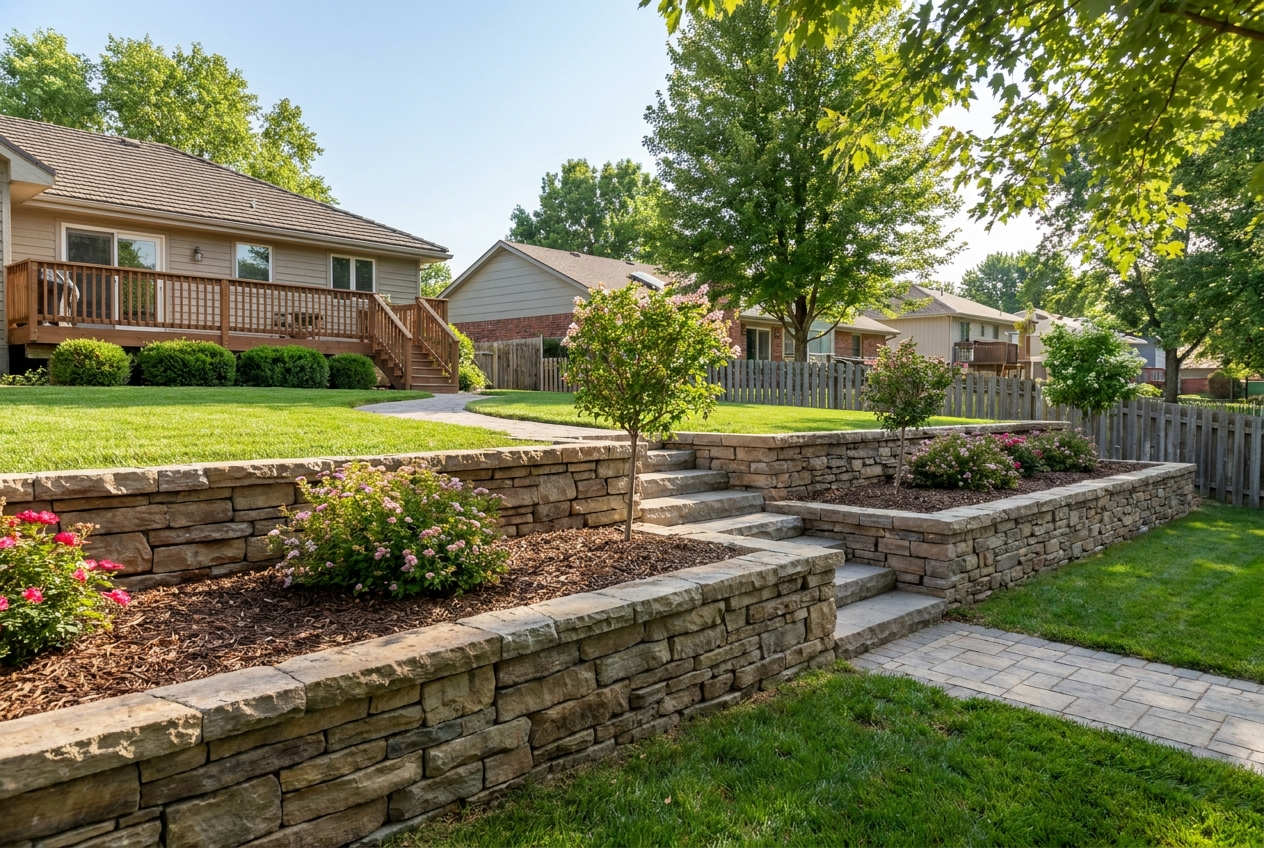


In 2026, building a retaining wall typically falls between $4,286 and $10,142, with many projects landing near $6,984. Material choice, wall height, and site conditions are some of the biggest drivers of retaining wall cost.
These ranges represent an average that reflects current market conditions and established landscape construction practices[1]. Below, you will find the main cost factors, how common materials compare, and practical hiring tips to help you plan a wall that performs well and looks right for your yard.
Key takeaways
Retaining wall projects can range from $4,286 to $10,142 depending on scope and materials.
Many homeowners see costs near $6,984 for a typical installation.
Concrete and natural stone are often premium choices; basic modular block or garden block styles can be more affordable, while engineered or decorative block systems can land in the mid to high range.
Site prep, drainage, and permits can significantly affect the total cost.
Hiring a licensed contractor can help reduce the chance of avoidable repairs by getting the base, drainage, and reinforcement right.
Retaining Wall Installation Cost by Material
Material selection affects your budget, the wall's lifespan, and the finished look. Some options cost more upfront but hold up better with less maintenance. Others are cheaper to install but may need repairs sooner.
Use the table below to compare materials, then ask contractors to bid the same wall design across your top choices so you are comparing apples to apples.
| Item | Cost | Description |
|---|---|---|
Concrete | $4,864 - $10,988 | Poured concrete has a clean, modern look and strong performance. It is often chosen for long runs or taller walls where durability and low maintenance matter most. |
Concrete Block | $4,128 - $9,826 | Block is modular and typically faster to install than poured concrete. Basic block can be budget friendly, while engineered or decorative systems can reach premium pricing. |
Natural Stone | $5,984 - $13,824 | Stone offers a timeless, high-end look and strong longevity. Costs are often higher due to labor and material handling. |
Boulder | $4,986 - $11,468 | Boulders create a rugged, natural barrier that blends into landscaping. Installation usually requires heavy equipment and careful placement, which increases labor. |
Wood / Timber | $2,284 - $7,426 | Timber walls are often economical and quick for low to moderate heights. They can look great, but usually need more upkeep and tend to have shorter lifespans, even when treated. |
Brick | $5,342 - $12,274 | Brick can match existing home masonry and delivers a classic finish. Proper footings and drainage matter, since shifting and moisture can damage mortar over time. |
Material pricing also depends on wall height, soil conditions, and access. Steep slopes or weak soils can require deeper footings, added reinforcement, or geogrid, which increases costs. If longevity is your priority, you may find it helpful to compare options using concrete retaining wall cost as a baseline.
Design decisions, especially around reinforcement and moisture management, influence both performance and overall cost[2]. Contractors commonly price excavation, base materials, drainage pipe, labor, and any required engineering or permits, not just the visible wall face.
Cost to Build a Retaining Wall by Type
Retaining wall services often include installation, replacement, repairs, inspection, waterproofing, sealing, and removal. Costs vary based on the size of the wall, site access, material weight, and the amount of drainage and excavation involved. Segmental and concrete block systems are widely used for many residential projects[3]. If your wall is part of a larger yard overhaul, it may also connect to broader landscaping investments.
| Type of Service | Cost | Features |
|---|---|---|
Install Retaining Wall | $4,286 - $10,142 | New wall construction, including footings, drainage, and finish materials; commonly used for slope control and creating level planting areas. |
Replace Retaining Wall | $5,628 - $12,684 | Removal and rebuilding of a failed wall, often needed when there is significant settlement or structural damage. |
Repair Retaining Wall | $986 - $4,162 | Targeted fixes like re-leveling, replacing blocks, repairing footings, and correcting drainage. |
Remove Retaining Wall | $1,286 - $4,184 | Demolition and disposal; pricing depends on material weight, access, and disposal requirements. |
Inspect Retaining Wall | $214 - $512 | Assessment of structural condition, drainage, and erosion risks; useful before major landscaping changes or property purchases. |
Waterproof Retaining Wall | $1,184 - $4,486 | Membranes, drainage mats, and related backfill work to reduce moisture migration and freeze-thaw damage on appropriate wall types. |
Seal Retaining Wall | $428 - $1,628 | Surface sealing to reduce water penetration and staining; often part of routine maintenance for some materials. |
Install Retaining Wall Costs
Installation generally includes site prep, layout, base material, drainage, and wall construction. Costs commonly range from $4,286 to $10,142, with an average near $6,984. Height, material selection, grading needs, and permit or footing requirements tend to drive the biggest swings.
Repair Retaining Wall Costs
Repairs address issues like bulging, leaning, displaced units, or drainage failures when the wall is still largely salvageable. Typical pricing runs from $986 to $4,162, with an average near $2,148. Access, the amount of movement, and whether materials can be reused often determine where your project lands in the range.
Replace Retaining Wall Costs
Replacement involves demolition and rebuilding, usually because the structure is failing or the base and drainage were not built correctly the first time. Expect $5,628 to $12,684, averaging $8,746. Replacement frequently overlaps with other hardscape costs, especially when adding terraces, steps, or integrated features.
Waterproof Retaining Wall Costs
Waterproofing is most common for solid walls holding saturated soils or walls close to foundations, where moisture and hydrostatic pressure can shorten service life. Costs range from $1,184 to $4,486, with an average near $2,462. Full membrane systems are most typical on poured concrete or masonry walls near structures; many segmental block and dry-stacked stone walls depend more on proper drainage and free-draining backfill than full waterproofing.
Retaining Wall Cost Per Foot by Size
Size and layout explain many of the cost differences you will see in estimates. Taller or longer walls require more material, deeper bases, and more labor. Slope changes, drainage requirements, and finish details can also add time and materials.
Soil conditions and groundwater can affect structural needs, and in some cases contractors may recommend geotechnical input for stability planning[4].
Small Garden Retaining Wall (Up to 3 Feet High)
Garden walls are often under 3 feet tall and used around flower beds, planters, or small grade changes. These projects commonly use stacked stone, timber, or short block systems. Many low walls do not require formal engineering, but local requirements can still apply based on total height, loads, or location, so confirm rules before work begins.
- Cost Range: $2,368 - $5,624
- Average Cost: $3,846
Access is usually the main time factor. Hauling soil out, bringing in base material, and restoring the area can add labor. Contractors may also include topsoil and fill dirt costs if the project requires grading and planting.
Property-Border Retaining Wall (Low to Moderate Height)
Border walls often run along lot lines or protect sloped yard edges. They commonly sit around 2 to 4 feet high and may include steps or small drainage features. Since they can affect adjacent properties, plan for clear communication with neighbors and confirm setback rules early.
- Cost Range: $3,842 - $8,846
- Average Cost: $6,128
Walls near property lines can trigger permits. Tight access can also increase labor if crews cannot use equipment efficiently. Material choice matters as well, natural stone and custom block typically cost more than timber or basic modular systems.
Tiered Retaining Wall (Multiple Levels on a Slope)
Tiered walls create terraces by breaking a steep slope into multiple shorter walls. Each level needs its own base prep and drainage planning, which increases labor and materials but can improve stability and usability.
- Cost Range: $7,248 - $16,382
- Average Cost: $11,286
Expect added costs for multiple runs, additional drainage components, and more layout time. Landscaping between tiers can also extend the schedule.
Large Landscape Retaining Wall (Long Runs or Over 4 Feet High)
Walls over 4 feet tall, or walls that run long distances, often require reinforced systems, engineered block, or poured concrete construction. They are common along driveways, berms, and large property edges.
- Cost Range: $8,124 - $18,466
- Average Cost: $12,682
Engineering, deeper excavation, heavier equipment, and possible shoring can all raise costs. Haul-away of excavated material and difficult access are also frequent budget drivers.
Custom Retaining Wall (Curved, Decorative, or Engineered Designs)
Custom walls may include curves, integrated seating, planters, special textures, or higher-end finishes. These projects typically involve more layout work, more precise cuts, and sometimes coordination with additional trades.
- Cost Range: $7,826 - $16,792
- Average Cost: $11,844
Customization tends to increase both labor hours and material costs. If your design is highly detailed, expect a higher per-foot price and a longer timeline.
Retaining Wall Cost Per Square Foot
Some contractors price retaining walls per square foot to help account for wall height, but many still bid by linear foot or as a flat project price. If you receive a lump-sum quote, you can ask the contractor to translate it into a square-foot figure for easier comparison.
Per-square-foot pricing often excludes major site work, such as extensive excavation, slope stabilization, or specialty finishes. Use it as a screening tool, then ask for a clear line-item scope before signing.
| Service Type | Cost | Details |
|---|---|---|
Install Retaining Wall | $28 - $61 | Cost depends on material, wall height, and access; typically includes standard labor and basic backfill for straightforward installs. |
Replace Retaining Wall | $36 - $74 | Costs increase when demolition, disposal, and rebuilding foundations and drainage are needed. |
Repair Retaining Wall | $12 - $42 | Repairs range from minor resets to rebuilding sections; drainage corrections can increase cost. |
Remove Retaining Wall | $8 - $23 | Removal reflects demolition labor, hauling debris, and site restoration. |
Retaining Wall Waterproofing | $7 - $22 | Waterproofing adds membranes or coatings to manage seepage; soil conditions and drainage needs affect scope. |
Retaining Wall Sealing | $3 - $8 | Sealing helps protect surfaces from moisture and staining; product type and coverage needs affect pricing. |
Material choice, wall height, and access are common drivers of square-foot pricing. Flat sites with easy equipment access usually cost less, while steep slopes, poor soils, or more involved drainage can push bids higher[5].
If you are comparing block retaining wall cost, ask what block system is specified and whether the design includes reinforcement, geogrid, or concrete footings, since those items can change square-foot pricing significantly.
Emergency Retaining Walls Costs
A failing retaining wall can create immediate safety and property risks. Emergency work often costs more because contractors may need to mobilize quickly, bring in equipment on short notice, and install temporary stabilization before a full repair or replacement.

Emergency installation and stabilization work typically runs $5,642 to $12,984, with same-day and after-hours repairs often priced above standard rates. Emergency pricing often reflects fast mobilization, access constraints, and the need to reduce immediate hazards first[6]. These conditions can increase labor costs and equipment scheduling, and may also add fees for expedited permits where required.
For safety, keep people and pets away from walls that are moving, leaning, or actively cracking. Before excavation, call 811 or your local utility locate service when possible. If a failure could impact sidewalks, streets, or a neighboring property, contact the appropriate local officials.
When you speak with emergency contractors, ask:
- What is temporary stabilization vs. permanent repair?
- What warranty, if any, applies to emergency work?
- Will they document conditions for an insurance claim?
If conditions allow, request at least two written emergency estimates with a clear scope before work begins.
7 Factors That Affect the Average Retaining Wall Cost
Retaining wall pricing in 2026 comes down to a handful of practical variables. Use the list below to compare bids and spot missing scope items.
- Material Type: Stone, concrete block, timber, and poured concrete come with different material costs and installation time. When you compare stone retaining wall cost to other materials, weigh appearance, maintenance, and expected lifespan.
- Wall Height and Length: Taller and longer walls need more material, deeper bases, and often additional reinforcement. Small increases in height can change the build method and permit requirements.
- Site Access and Labor: Steep slopes, narrow side yards, and limited equipment access can add hours for hauling and staging. Local wage rates and crew availability also affect pricing.
- Drainage and Erosion Control: Drainage helps relieve pressure behind the wall, so it is part of most projects. Taller walls may also need geotextile, geogrid, or engineered backfill design, which adds cost. Sites with erosion issues may also include erosion control costs as part of the solution. Using native plants and permeable surfaces can help reduce runoff and related maintenance over time[7].
- Foundation and Structural Reinforcement: Footings, geogrid, and tie-backs increase upfront cost but play a major role in stability. Undersized foundations can lead to early repairs and higher lifetime cost.
- Permits, Codes, and Engineering: Many areas require permits and may require engineering based on wall height, location, and retained loads. Confirm requirements early, especially near property lines, driveways, or structures.
- Finish, Facing, and Landscaping: Caps, facing stone, steps, and landscaping tie-ins add labor and materials. If you want a highly finished look, budget for those details from the start.
Retaining Walls Repair vs. Replacement Costs
Replacement rebuilds the wall from the ground up. Repair focuses on specific failures, such as bulging sections, displaced blocks, or drainage problems. HUD rehabilitation guidance discusses common issues to consider when evaluating repair versus replacement decisions[8].
| Option | Cost | Considerations |
|---|---|---|
Replace | $5,628 - $12,684 | Full replacement resets foundations and drainage and typically offers the longest remaining lifespan. Upfront cost is higher, but it can be a better long-term value. |
Repair | $986 - $4,162 | Repair targets specific problems and can lower initial cost, but the wall may have a shorter remaining service life and could need additional work later. |
When to Choose Replacement
Replacement is often the better fit when the wall shows widespread failure, has reached the end of its expected life, or has a history of recurring movement. It also makes sense when new footings or a corrected drainage system are needed to stop repeat damage, or when total repair costs are approaching a large share of rebuilding.
When to Choose Repair
Repair can be a good option for isolated issues, cosmetic fixes, or newer walls where the structure is still sound. If you are weighing several projects at once, you can compare these ranges to other exterior work using the site's home cost estimates, a directory of costs across services and categories.
ROI of Retaining Walls
A retaining wall can protect against erosion and make sloped outdoor space more usable, both of which can influence resale appeal in 2026. ROI describes how much value you may recover through improved marketability, reduced future damage, or avoided repairs. As a standalone project, retaining walls rarely relate to federal energy tax credits, so incentives are not usually a major part of the ROI conversation.
Key ROI Drivers
- Material Quality And Durability: Higher-quality materials often last longer and need fewer repairs, which can support stronger long-term ROI.
- Professional Installation: Drainage, footing prep, and compaction reduce the risk of early failure and expensive corrections.
- Market Demand: In markets where outdoor improvements matter to buyers, landscaping features can contribute to resale value[9].
- Maintenance Requirements: Lower-maintenance systems can reduce ongoing costs and help preserve value.
- Curb Appeal And Aesthetics: Walls that look intentional and match the landscape can improve buyer perception.
| Service | Estimated ROI | Details |
|---|---|---|
Basic Repair | around 40-55% | Minor stabilization can extend service life at a lower cost, but resale impact is often limited. |
Partial Replacement (modular blocks) | around 55-70% | Updated block systems can balance durability and cost, with solid curb appeal and manageable upkeep. |
Full Replacement (concrete or natural stone) | around 65-80% | More permanent materials can increase buyer confidence and reduce perceived future maintenance. |
Premium Landscape Integration | approximately 70-85% | Combining walls with terraces, lighting, and plantings can improve function and curb appeal. |
ROI is a guideline, not a promise. Results depend on your local market, lot conditions, workmanship, and how visible and useful the wall is to a future buyer.
Add-Ons for Retaining Walls
Add-ons can improve performance, appearance, and usability, but they also increase the project total. The table below highlights common upgrades and what they typically include.
| Add-On | Cost | Details |
|---|---|---|
Drainage System | $842 - $2,862 | Subsurface pipe, gravel backfill, and outlets to reduce pressure behind the wall. |
Landscape Lighting | $742 - $2,484 | Low-voltage fixtures and wiring mounted on or near the wall for visibility and safety. |
Capstone Installation | $686 - $1,984 | Top caps that protect the wall edge and create a finished look. |
Stepped Design | $1,128 - $3,568 | Tiered sections for steep grades; adds layout complexity and labor and can reduce effective wall height per tier. |
Custom Texture | $928 - $2,968 | Specialty finishes or veneers intended to match or elevate surrounding hardscape. |
Integrated Planters | $1,284 - $4,186 | Built-in planting areas that combine structure with softscape. |
Fence Integration | $1,186 - $3,746 | Posts and mounting hardware for fencing; may require engineering and additional code or permit steps. |
Add-on costs vary by material quality, detailing, and labor complexity. Planters and stepped designs can add excavation and layout time. Custom textures and premium caps can increase material costs and may require specialized installation.
Some upgrades can also contribute to curb appeal, especially when paired with cohesive planting design[10]. If drainage is a concern for your site, it can help to compare solutions such as the cost of french drains.
Retaining Walls Cost Per Hour
Hourly pricing is most common for small repairs, inspections, sealing, or short removal jobs. For full installations, many contractors prefer a flat project bid, since total time can vary significantly once excavation begins.

Hourly rates depend on access, slope, soil conditions, and crew size. Ask about minimum billable hours, what is included, and whether equipment and materials are billed separately. Request a written estimate showing expected hours and milestones. For larger builds, a clearly scoped lump-sum bid is often easier to budget than open-ended hourly work. Installation labor typically runs $96 to $172 per hour, with repair and inspection work often priced a bit lower. Hourly charges often align with local landscaping wage trends[11].
DIY vs Professional Retaining Wall Costs
DIY can reduce labor costs, but retaining walls depend on correct base prep, compaction, and drainage. This section compares cost ranges and practical trade-offs so you can choose an approach that matches your skills and risk tolerance.

DIY Risks, Challenges, and Limitations
DIY retaining wall construction often runs $1,842 to $4,826, compared with $4,286 to $10,142 for a professional crew. DIY projects can look straightforward, but small mistakes in drainage, backfill, or grading can lead to early failure. Working near trees can also create issues due to root pressure or root damage, and a certified arborist can help assess root impacts[12]. Permits and inspections are commonly missed, and that can create delays during resale or force expensive corrections later. Safety is also a real concern due to excavation near slopes, heavy lifting, and tool or equipment use. Homeowners may also be liable if an unpermitted or poorly built wall fails and damages neighboring property or public areas.
Professional Advantages and How to Choose
Professionals have experience with soil conditions, proper drainage details, and the equipment needed for stable construction. Contractors typically handle permits and inspections and may offer warranties and liability coverage. For taller or load-bearing walls, professional planning can reduce the risk of repeat repairs and help the project move faster and more safely.
DIY is usually best for short, decorative walls on stable soil when you have the time and hands-on building experience. Hire a professional when the wall retains significant soil, manages runoff, supports a driveway or structure, or sits on a steep slope. Professional help is also a better fit when engineered plans, permits, or heavy equipment access are part of the scope.
How Seasonality Impacts Retaining Wall Costs
Scheduling affects both cost and lead time in 2026. Contractor demand changes throughout the year, and weather can limit excavation and concrete work in many climates. Coordinating retaining wall work with planting and landscaping can also support soil stabilization and overall site performance[13].
| Season | Cost | Description |
|---|---|---|
Spring / Early Summer | $4,362 - $10,294 | Demand often increases after winter, which can tighten scheduling. Ground conditions are workable in many regions. |
Summer Peak Season | $4,498 - $10,584 | High demand can raise labor costs and extend lead times. Hot conditions can speed some work but may affect scheduling and materials. |
Autumn / Fall | $4,098 - $9,844 | Demand often eases, improving availability. Cooler weather can be more comfortable for crews and suitable for many installs. |
Winter Off Season | $4,186 - $10,328 | Frozen or saturated ground can restrict excavation and concrete work, causing delays or added prep; some regions postpone installs during hard freezes. |
Rainy Season | $4,588 - $10,866 | Wet soil can increase erosion and slow excavation, sometimes requiring extra staging and drainage measures. |
During peak seasons, contractors may book out weeks in advance, and pricing can reflect limited availability. Weather can add steps like dewatering, frost mitigation, or longer cure times, which increases labor and materials. If your site allows it, off-season scheduling can sometimes reduce lead times and overall cost.
How Much Does a Retaining Wall Cost by State
State pricing varies due to labor rates, material availability, delivery distance, local demand, and permit or engineering requirements. Use the ranges below as a starting point, then get written local quotes based on your site.
| State | Cost | Details |
|---|---|---|
California | $5,184 - $12,284 | Higher labor and permit costs in many areas, plus transport distance, can raise pricing. Coastal and seismic considerations may require stronger designs. |
Texas | $4,024 - $9,586 | Costs can vary widely by region. Soil types and stormwater rules can influence the build approach and total price. |
Florida | $4,482 - $10,512 | High groundwater and storm considerations can increase drainage and anchoring requirements. Seasonal demand can also affect contractor rates. |
New York | $5,026 - $11,968 | Urban labor, disposal logistics, and permitting can increase cost. Winter conditions can limit scheduling windows. |
Illinois | $4,218 - $9,984 | Moderate labor rates, with durability and drainage needs influenced by freeze-thaw cycles. Pricing is typically higher around major metros. |
Washington | $4,628 - $10,964 | Rainy conditions can increase drainage and erosion-control needs. Urban labor costs may be higher. |
Colorado | $4,568 - $10,744 | Terrain, access, and seasonal scheduling can raise excavation and hauling costs. Engineering for slope stability may be more common. |
These state ranges can help with early budgeting, but your actual price will depend on drainage, access, wall height, and local requirements. In some areas, engineering may be required for certain wall designs or site conditions, which can add design and review costs. For a more accurate total, get written quotes from contractors who can evaluate your site and confirm permit needs. Some homeowners may also qualify for assistance programs[14].
How to Save on Retaining Walls
You can often lower costs without cutting corners by planning the scope carefully and preventing avoidable change orders. It can also help to coordinate with tree professionals and local maintenance expectations when roots or public areas are involved[15].
- Plan Around Site Conditions: Identify slopes, access points, and utilities before bidding so contractors can price accurately.
- Choose the Right Design: Straight runs and consistent heights are usually faster to build than curves and frequent step-downs.
- Compare Material Tradeoffs: Ask for side-by-side options, and include wood retaining wall cost in your research so you can weigh upkeep and lifespan along with appearance.
- Prioritize Proper Drainage: Drainage and base prep are where failures often start. Do not reduce scope on reinforcement, footing size, or backfill to save money short term.
- Source Local or Reclaimed Materials: Locally available materials can reduce delivery costs and lead times.
When you are ready to move forward, retaining wall contractors on homeyou can provide estimates, verify permits, and suggest durable approaches that fit your site and budget.
Frequently Asked Questions About Retaining Walls
References
[1] Sorvig, Kim, and J. William Thompson, "Sustainable Landscape Construction", https://doi.org/10.5822/978-1-61091-811-4.
[2] U.S. Department of Housing and Urban Development, "Durability by Design A Guide for Residential Builders and Designers", https://huduser.gov/portal/sites/default/files/pdf/Guide-Durability-by-Design.pdf.
[3] Concrete Masonry and Hardscapes Association, "Segmental Retaining Walls - Concrete Masonry and Hardscapes Association", https://masonryandhardscapes.org/building-solutions/segmental-retaining-walls.
[4] A. Eastwood, David, "RECOMMENDED GUIDELINES FOR DESIGN AND CONSTRUCTION OF INGROUND SWIMMING POOLS IN HOUSTON, TEXAS", GEOTECH ENGINEERING and TESTING, https://foundationperformance.org/pastpresentations/EastwoodPresPaper-12Sep07.pdf.
[5] Hansen, Gail, et al, "Landscape Design Software: Evaluation and Recommendations for Homeowners", EDIS, https://doi.org/10.32473/edis-ep526-2015.
[6] Abbott, Richard, and Kenneth Miller, "Estimating and Pricing Tree Care Jobs", Arboriculture & Urban Forestry, https://doi.org/10.48044/jauf.1987.025.
[7] United States Environmental Protection Agency, "Resource Conserving Landscaping", https://archive.epa.gov/.
[8] U.S. Department of Housing and Urban Development, "The Rehab Guide Foundations", https://huduser.gov/publications/pdf/foundations.pdf.
[9] Rosiers, François D., et al, "Landscaping Attributes and Property Buyers' Profiles Their Joint Effect on House Prices", Housing Studies, https://doi.org/10.1080/02673030701608183.
[10] Anderson, L. M. and H. K. Cordell, "Residential Property Values Improved by Landscaping With Trees", Southern Journal of Applied Forestry, https://doi.org/10.1093/sjaf/9.3.162.
[11] Bureau of Labor Statistics, "Landscaping and Groundskeeping Workers", https://bls.gov/oes/2022/may/oes373011.htm.
[12] International Society of Arboriculture, "ISA Certified Arborist", https://isa-arbor.com/credentials/types-of-credentials/isa-certified-arborist.
[13] Brancalion, Pedro H. S. and Karen D. Holl, "Guidance for Successful Tree Planting Initiatives", Journal of Applied Ecology, https://doi.org/10.1111/1365-2664.13725.
[14] "Government Home Repair Assistance Programs", USAGov, https://usa.gov/home-repair-programs.
[15] O'Brien, Patrick, et al, "Performance Standards for Municipal Tree Maintenance", Arboriculture & Urban Forestry, https://doi.org/10.48044/jauf.1992.059.


